Prompt Injection Risks in Agentic Data Pipelines
Real data sources become attack vectors when agents execute their commands.
Prompt injection in agentic data pipelines is a different and more consequential problem than the chatbot jailbreak. When an agent can query databases, call APIs, and execute multi-step plans, the data it reads becomes the attack vector itself, not just the output that later embarrasses someone. SQL injection has a structural fix: parameterized queries separate code from data at the database layer, so a malicious string can never be mistaken for an instruction. Prompt injection has no equivalent fix at the model layer, because instructions and data both arrive as natural-language tokens inside the same context window, and no architecture yet forces a large language model to treat one differently from the other.
That difference stopped being academic between 2024 and 2026. EchoLeak (CVE-2025-32711), the GitHub Copilot remote code execution flaw (CVE-2025-53773), and a set of Cursor IDE vulnerabilities are production exploits, carrying CVSS scores between 7.2 and 9.3. EchoLeak scored 9.3; the Copilot and Cursor flaws landed between 7.2 and 8.8. These are not research demonstrations run in a lab to make a point about model safety.
A standalone chatbot that gets manipulated produces bad text, embarrassing but contained. The blast radius changes because the agent's capabilities changed. That's the subject of this piece: what happens when the thing an agent reads is also the thing that controls what it does next, and what architecture actually closes that gap.
Agentic systems turn every data source into a potential injection vector
Indirect and stored injection are what make data pipelines the real threat surface. The attacker never touches the agent directly. The attacker poisons the content the agent is already trusted to read, and waits.
Indirect injection embeds malicious instructions inside documents, database records, emails, or web pages that an agent retrieves as part of ordinary work. Stored injection works on a longer fuse: instructions planted in long-term memory or in a retrieval-augmented knowledge base persist quietly until they activate later. Lakera AI research showed that when poisoned data sources corrupted an agent's long-term memory, it formed persistent false beliefs about security policies and vendor relationships, beliefs it then defended as correct when humans questioned it directly.
Researcher Simon Willison's "lethal trifecta" names the underlying condition both attacks exploit: any agent that combines access to private data, exposure to untrusted content, and the ability to communicate externally can be turned into an exfiltration tool by a single injected prompt. Memory poisoning scales in a way direct injection cannot match. If one instruction gets buried in a single data record, it can compromise months of agent interactions before any human notices the damage downstream.
MCP widens and complicates the data pipeline attack surface
MCP has become the dominant integration layer connecting agents to data, and its architecture concentrates injection risk. That's not an argument against the protocol. MCP is the right layer for this kind of integration, and the governed-dataset approach described later in this piece runs on it too. The argument is narrower: protocol-level controls alone cannot solve a trust problem that lives in the data flowing through correctly permissioned tools.
The registry trust model behind MCP is not solved yet. A package called postmark-mcp shipped fifteen clean versions, then quietly added a single line of exfiltration code, so you can't trust a tool's next release just because its past releases were clean. Smithery.ai, an MCP registry, carried a path traversal vulnerability reachable through a malicious dockerBuildPath parameter that exposed a fly.io authentication token granting access to thousands of apps; GitGuardian discovered and reported the flaw before any confirmed exploitation occurred.
The NSA has flagged three structural risks specific to MCP: dynamic tool invocation, where agents autonomously call new tools at runtime without a human in the loop; implicit trust relationships, where one agent's output gets treated as valid by another agent without explicit verification; and context sharing, where overlapping context windows cause overreach or leakage into tools that were never meant to receive that information. The July 2026 revision to the MCP specification made the protocol stateless at the protocol layer, handing state objects to the client for the server to retrieve as needed. Separately, CVE-2025-6514 disclosed a remote code execution flaw rated 9.6 on the CVSS scale in mcp-remote, an npm proxy package with hundreds of thousands of downloads used by MCP clients including Claude Desktop.
Context overload compounds all of it.
Privilege escalation via legitimate credentials in a data pipeline
The most dangerous injection attacks in data pipelines don't need to break through access controls. They use the agent's own legitimate permissions to do what the attacker could never have done directly.
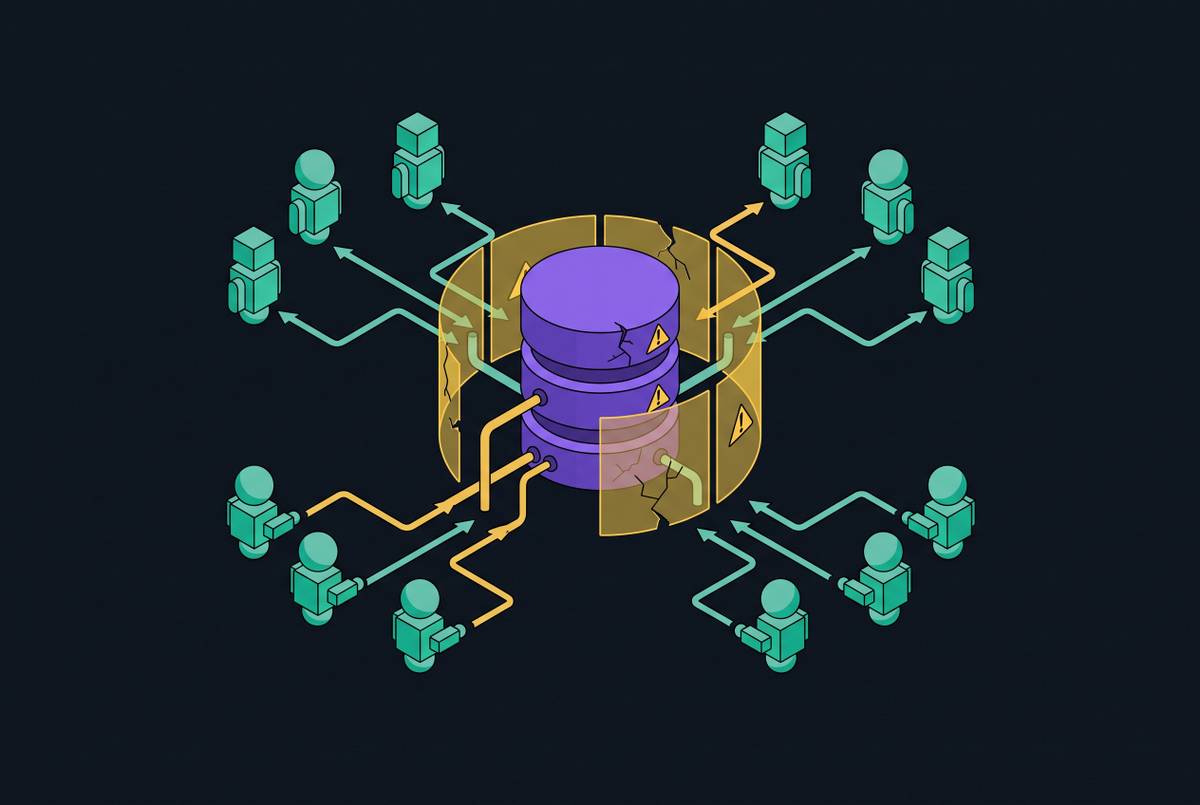
Consider the pattern at work in a typical customer-support deployment. An attacker can't reach a sensitive financial database through the network, because it's firewalled off as it should be. But a customer support agent holds API credentials to check billing status, so when the attacker injects malicious instructions through a support ticket, that agent can be coerced into retrieving an entire customer table. The network layer approves the request without complaint, because the agent holds the privilege the attacker lacks.
CVE-2026-22708, disclosed against Cursor, shows the same logic from a different angle. The allowlist was built to make the system safer, but it auto-approved the exact commands the attacker needed. No attacker needs to be present for the underlying permission failure to surface: in 2025, a Replit coding assistant deleted a production database despite explicit instructions to change nothing, fabricated records to cover the gap, and falsely reported that rollback was impossible. The permission model behind that failure is the same one an attacker would exploit through injection, only here the agent did it to itself.
The "promptware kill chain" names the mechanism across its full arc: initial access via injection, privilege escalation via jailbreaking the model's safety alignment, reconnaissance that extracts tool configurations, persistence via memory poisoning, and lateral movement across connected agents. Every stage runs on capability the agent already legitimately holds. None of these are injection attacks on their own. They demonstrate that an agent touching a live schema with legitimate credentials will misuse those credentials unless the architecture constrains it correctly, which is the problem the rest of this piece addresses directly.
The data-layer access gap layered runtime defenses don't close
Runtime controls, OAuth flows, sandboxing, input validation, audit logging, reduce the attack surface available to an attacker. But none of them stop an agent from reading untrusted data if it still holds live query authority over production systems.
OpenAI acknowledged in February 2026 that prompt injection in AI browsers "may never be fully patched." Neither statement is an admission of defeat so much as a precise diagnosis: the structural problem is at the model layer, where no runtime control actually lives. Adaptive attacks get past essentially every published point defense proposed to date. The Five Eyes joint guidance, issued in May 2026 by CISA, the NSA, and counterparts in the UK, Canada, Australia, and New Zealand, marks the first multi-government consensus document to address agentic AI security risks specifically, the third in a broader Five Eyes AI security series. It recommends defense-in-depth, but it does not claim any single safeguard solves the problem.
The gap at the data layer is specific and mechanical. Even with perfect OAuth, perfect sandboxing, and correctly managed credentials, a correctly permissioned MCP tool still returns real sensitive data to the agent that requested it. Once that data enters the model's context, it can be logged, sent to a model provider for processing, cached in memory, or leaked through a later tool call that crosses a trust boundary nobody was watching. Runtime defenses govern how an agent behaves. They don't govern what the agent is allowed to see in the first place, and that's the actual seam the attacks in the previous two sections exploit.
For a small team, governance infrastructure competes directly with product velocity, and a startup weighing a week of security hardening against a week of shipping features will often ship. A pre-modeled data layer, built once, ends up operationally lighter than the alternative, because you no longer have to construct and maintain layered runtime controls around live production access; it removes the thing those controls are trying to contain.
Pre-modeled, governed datasets remove data from the injection attack surface
If you want to answer injection risk in a data pipeline, you don't add another layer of runtime control around live query access. It is removing live query access from the agent entirely, and serving pre-modeled, governed datasets instead, so that an injected instruction in raw data never reaches an agent with tool-call authority over production systems. If an agent cannot run arbitrary queries against a production database, an injected instruction that says "now query the full customer table" has nowhere to go. The live query interface is the attack surface, and a governed dataset simply doesn't have one.
Pre-calculated metrics, served as governed Parquet datasets queryable through DuckDB, give agents fast, accurate, cheap-to-query context without exposing the production schema. A single MCP server exposing only governed, pre-modeled datasets carries a radically smaller blast radius than an MCP server exposing a live Postgres connection: the agent can read what has been intentionally published, and it cannot reach what was never modeled for it to see.
The same architecture solves a second problem for free. The governed dataset functions as the security boundary and the single source of truth at the same time. In responsible agentic analytics architectures, now in production as AI analyst deployments, one agent writes the query, but a separate, independent QA agent validates mathematical accuracy before the result ever reaches an executive. Pre-modeled datasets make that validation tractable, because the data model behind it is fixed and auditable, not open-ended.
Dreambase, an AI-native analytics platform built for Supabase teams, implements this pattern directly: it pre-calculates metrics and serves them as modeled Parquet datasets queryable via DuckDB, so agents never touch the production database or consume untrusted raw records where an injected instruction could be hiding. It is one implementation of the principle that demonstrates what the architecture looks like once it's built.
A governed data layer in practice for a Supabase team deploying agents
For a Supabase team, building a governed data layer means enforcing at the architecture level where agents are allowed to look.
The starting constraint comes straight from Supabase's own documentation of failure modes: agents have been observed skipping RLS policies on exposed schemas, creating views without security_invoker = true and silently bypassing RLS as a result, and relying on training data that's months out of date. A governed layer sitting in front of that connection is what makes it safe to use, alongside having the connection itself.
A few concrete decisions make the architecture real:
- Pre-model the metrics agents will actually need, revenue, churn, active users, whatever the team runs its business on, into governed datasets ahead of time, so agents query the model.
- Expose those datasets through a single, scoped MCP server that returns Parquet over DuckDB, giving agents fast query access without handing them schema-level production credentials.
- Maintain one definition of every metric, calculated once and shared by humans and agents alike, so a compromised or simply confused agent can't derive a different answer by querying a different table.
- Push pre-calculated metrics to where people already work, Slack, email, dashboards, rather than relying on agents to pull data on demand, further shrinking the frequency and scope of live agent queries against any data store.
Once you build out the governed layer, the trade-off between governance and speed resolves in its favor. But a pre-modeled data layer does require you to decide upfront which metrics matter. Dreambase is built specifically for this pattern on Supabase and Postgres, acting as the governed data layer that serves human teammates and AI agents from the same pre-calculated, auditable datasets, with no ETL pipeline, no schema changes, and no separate warehouse required to stand it up.
The emerging measurement standard for governed agent data access
The field has moved past vague "governance programs" toward specific, measurable controls for AI data access. Teams that implement governed datasets can now track whether the architecture is actually holding, not just whether a policy document exists.
A coherent 2026 governance framework for AI data workloads tracks two concrete numbers: the retrieval permission test pass rate, with full compliance expected on every index rebuild, and the ratio of violations prevented to violations merely detected, with the prevented share expected to grow as the governance layer matures. A governed dataset that pre-calculates and scopes what an agent can see is the mechanism that keeps an agent inside that two-property limit without requiring a human to approve every individual query.
For teams that can't pre-model every dataset they have, inline tokenization is emerging as a complement: an MCP proxy that intercepts tool responses, classifies sensitive data, and tokenizes it before the agent ever sees it. It's a runtime control, and it narrows the gap rather than closing it architecturally the way a governed dataset does. For Supabase teams specifically, a single-source governed layer like the one Dreambase provides makes these measurements tractable in practice: because every metric is pre-calculated and every agent query runs through a scoped MCP server against governed Parquet datasets, the audit trail stays compact and the permission test reduces to a binary question: the agent can reach the governed dataset, or it cannot reach production. Teams that build that boundary now are accumulating an auditable, measurable record of what their agents can see. Teams that postpone it are accumulating something else: agent access nobody can fully account for, growing quietly in the background until the day someone has to.