AI Data Sprawl in Multi-Agent Systems
Govern agent data access through a centralized layer, not direct database queries.
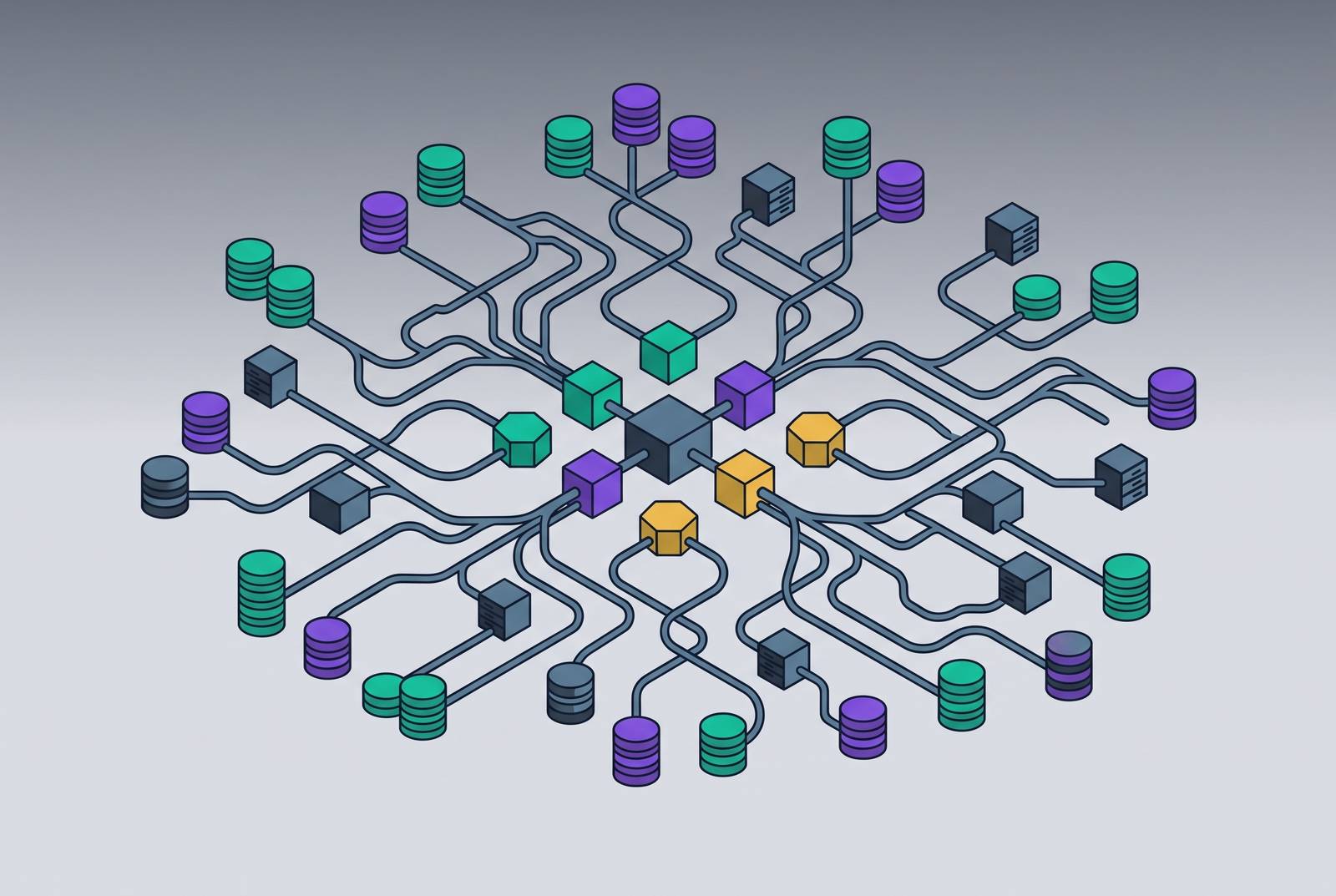
AI data sprawl in multi-agent systems is an architecture problem. To give AI agents governed access to Supabase via MCP without direct database access, route their queries through a shared layer of pre-modeled datasets with defined metrics, enforced permissions, and access logs. The essential separation is between the production tables that run the application and the governed data that agents consume.
How multi-agent systems produce data sprawl structurally, not accidentally
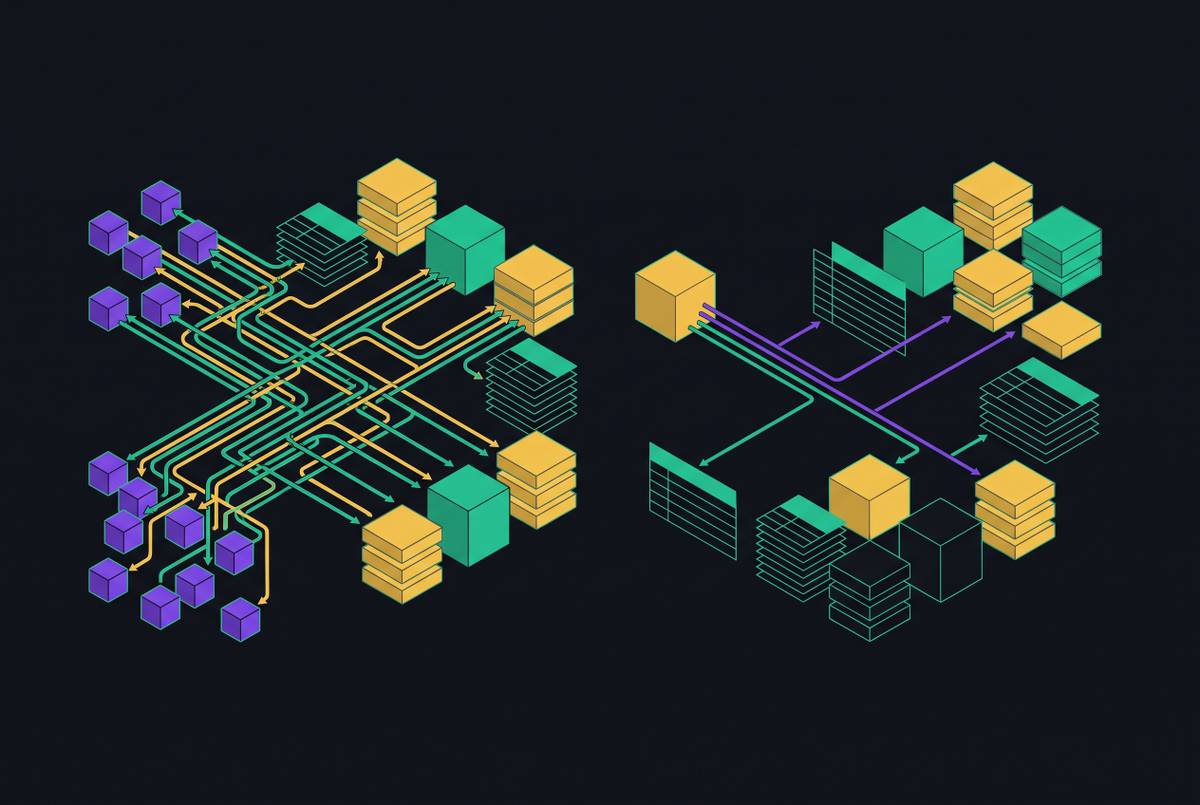
Teams build agents independently, and each agent reaches for data wherever it can. One team creates a pipeline for its task, while another builds a separate path to the same underlying records. Each decision solves a local problem, but neither establishes which interpretation of the data should govern the wider system. As these paths multiply, the organization acquires several versions of the truth without deliberately choosing any of them.
The fragmentation extends beyond duplicated pipelines. Multiple agents perform similar tasks, ownership becomes unclear when builders leave, and agents share data or call each other through undocumented dependencies. Without centralized monitoring, there is no single place to see what is running, failing, or costing money. Governance gaps follow when those agents make decisions or take actions that have not been explicitly authorized. The system’s collective behavior becomes harder to understand than any of its individual parts.
Intentional multi-agent design has a different structure. It assigns defined roles, establishes clear handoffs, and coordinates agents centrally. Sprawl emerges when agents accumulate without those boundaries, even if each agent is useful and capable within its own task. Improving one model does not fix the undocumented data dependencies between agents. The connections and access paths contribute to the problem alongside the components.
Why sprawl follows a predictable three-stage progression
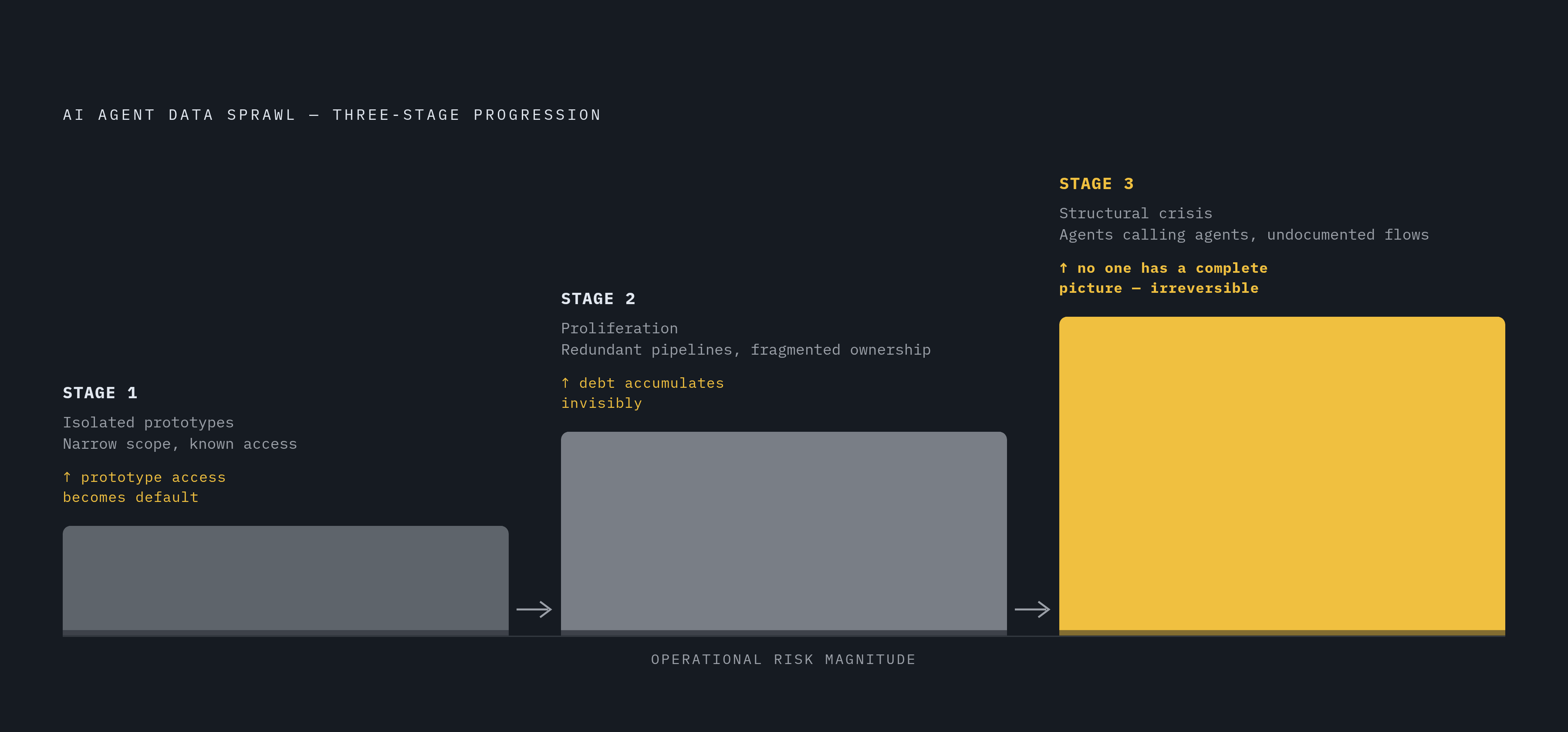
The progression begins with Stage 1, isolated prototypes. Agents are simple, narrowly scoped, and owned by the people who built them, so the environment remains understandable. Risk grows when the way a prototype gets access becomes the default for every agent built after it. What worked within one bounded task becomes an unexamined pattern across the organization.
Stage 2 is proliferation without coordination. More teams want agents, and vendors introduce embedded agents into tools the organization already uses. Each addition serves a real need, but independent development creates redundant pipelines and fragmented responsibility. Operational debt grows because each new agent seems too small to call for a change to the architecture. Organizations can therefore leave Stage 1 without recognizing that the conditions which made it manageable have disappeared.
Stage 3 is structural crisis, when agents call other agents and data is processed or combined in undocumented ways. No one has a complete picture of what is running or what it is doing to production data. The microservices parallel is brief but instructive, since the same pattern in the late 2010s took most organizations three to five years to internalize, often after a serious production incident or surprise infrastructure bill. The progression is predictable because each locally reasonable step increases the system’s untracked dependencies.
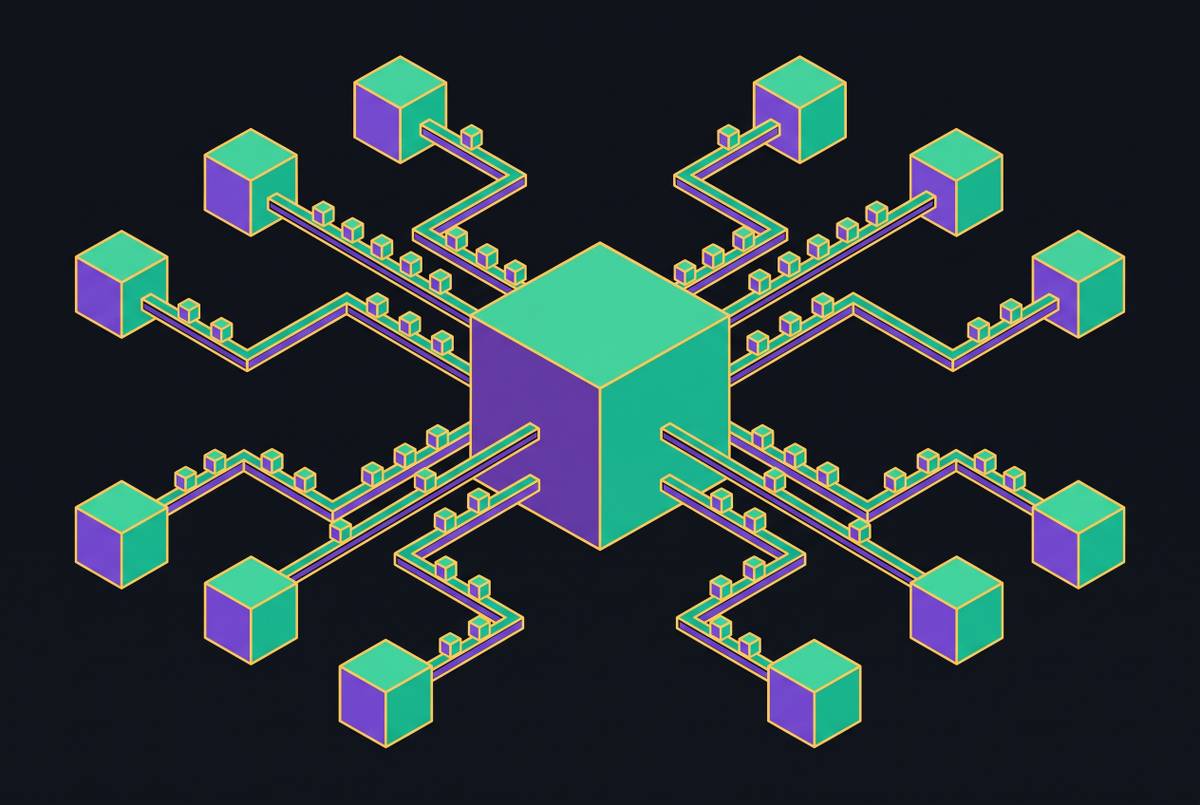
A shared governed layer established before proliferation interrupts that progression at its source. Agents consume common datasets instead of building independent paths into production, preventing the data redundancy and hidden dependencies that drive the later stages. For Supabase teams, platforms like Dreambase serve this role by pre-modeling datasets that agents query from a common layer.
What sprawl does to data: conflicting outputs, compliance violations, and production risk
The first consequence is conflicting outputs from the same underlying data. Separate pipelines allow agents to apply different definitions and transformations, yet the resulting answers can appear equally authoritative. Without a shared data layer, the system has no agreed way to settle that disagreement. Automation then distributes the inconsistency. What looks like a reporting discrepancy is a failure to establish authority before execution.
Compliance violations can emerge between agents whose individual permissions appear acceptable, making the risk harder to see. A compliance reporting agent can ingest unmasked PII from a data quality agent’s intermediate output, violating GDPR without either agent exceeding its access boundaries. Governance must cover the chain of processing.
Direct production access adds another exposure. Autonomous queries introduce load, schema assumptions, and access patterns that production systems were not designed to handle at agent speed and volume. Broad tool permissions add to that risk, especially when agents no longer have owners who look after them. Keeping analytical access separate from production helps control the system as well as tune its performance.
Even a secure query can still produce the wrong answer. An agent given tables without semantic context must guess what the data means, including which definition of a metric applies. Different definitions then give different answers to the same business question. The governance gap is ultimately an accuracy problem as well as a security problem.
Why a governance-as-code policy model is the necessary condition for safe agent data access
A human-readable policy cannot enforce itself against an autonomous action. The instruction “access should be approved by management” expresses intent but gives a policy engine no executable decision. By contrast, “DENY SELECT * queries returning more rows than a certified threshold from the customer_data schema for agents without explicit bulk-access certification” defines a condition that software can evaluate. Governance-as-code turns policy from a document into a constraint on execution. That distinction is a prerequisite for safe agent access.
The constraint must apply to every attempted action. Evaluation must consider the content of the request, prior actions in the session, and current business context. This is particularly important when one agent consumes another agent’s output. Permission to start a workflow cannot stand in for permission to perform everything that follows.
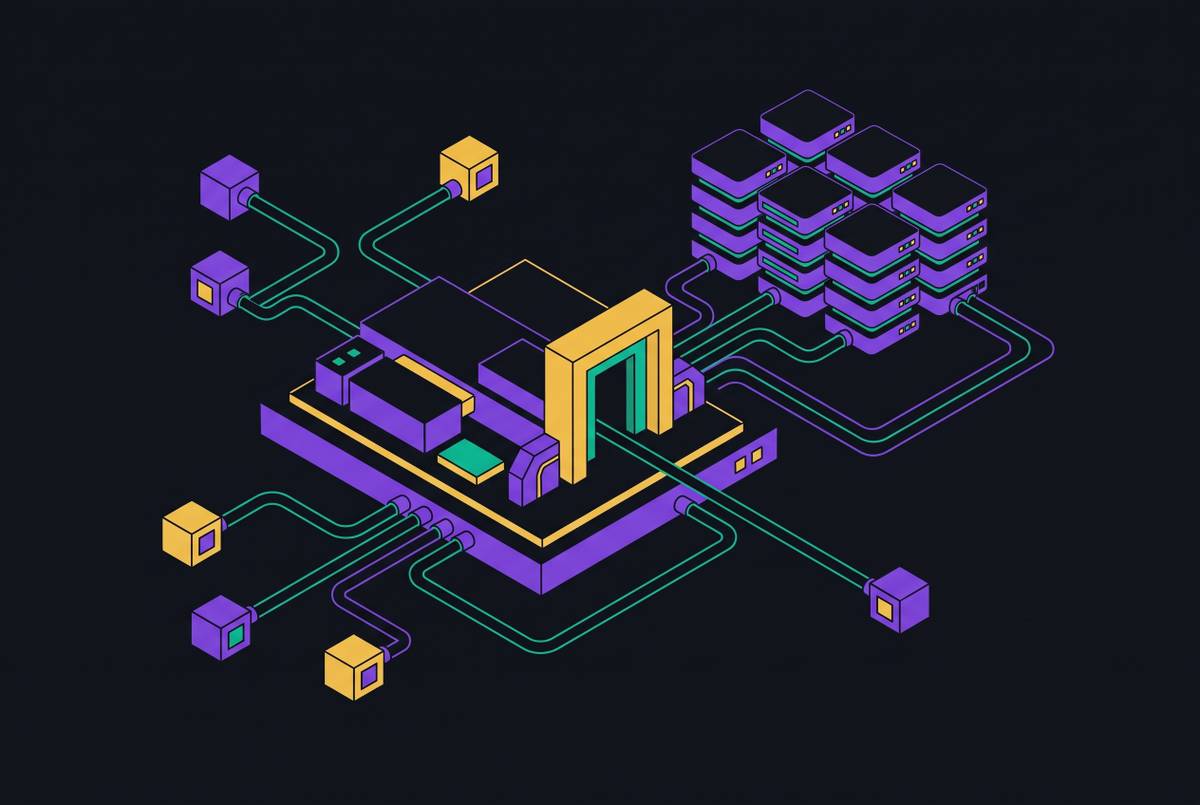
Least privilege supplies the foundational rule. Agents should never have production database credentials embedded in their configuration, and all agent database queries should pass through a centralized gateway that enforces permissions and logs access. Analytical queries must go to read-optimized surfaces isolated from production databases. Under this model, isolation is a governance requirement.
This is the practical meaning of “Trust by Design”. Security is built into the architecture rather than applied externally to an individual workflow. As a result, protection does not depend on which orchestration path an agent takes. The architecture must constrain access before a request reaches data, instead of relying on agents to interpret policy correctly.
What a governed data layer must actually look like to serve agents safely and consistently
A governed data layer must give agents both semantic context and a way to query the data. An agent with context but no access cannot answer, while an agent with access but no context guesses at meaning. Permissions alone solve neither problem. The layer must expose pre-modeled datasets and pre-calculated metrics whose meanings are already defined.
This changes the unit of analytics. Instead of an ad-hoc query built independently by each agent, the unit becomes a modeled dataset that humans and agents can both use safely. One metric definition must hold across those consumers, because access control cannot reconcile incompatible definitions. Pre-calculation makes the agreed metric available as data for reuse by every consumer. The semantic model becomes an enforced part of the infrastructure.
MCP provides an interface standard for access to that layer, but it is not itself a data platform. Identity, governance, semantic grounding, query performance, lineage, cost controls, and auditability must exist underneath the interface. If agents can select raw query tools instead of approved metrics endpoints, they can bypass semantic governance. Approved metrics must be the default and easiest path.
The datasets also need an execution surface isolated from production. A read-optimized engine such as DuckDB over Parquet can serve fast, accurate, cheap-to-query context without giving agents a path to production writes or schema modifications. Every query against the governed layer must be logged to create the audit trail needed to spot agents going around it to reach production directly. Dreambase combines governed datasets with a single access point for Supabase teams, making this separation concrete.
How can Supabase teams give AI agents governed MCP access without adding a warehouse?
Teams that have already chosen Supabase and Postgres should not need a separate warehouse to establish governed agent access. Postgres can support analytics when the architecture has the right access patterns, connection management, and pre-modeled datasets. Supporting analytics requires separating analytical consumption from the connections and workloads that serve production. Teams must choose how to expose governed data through the existing database.
The Supabase agent-skills repository covers query performance, connection management, Row Level Security, schema design, and concurrency. These are central concerns because missing indexes, RLS bypasses, and connection pool exhaustion can cause production agent failures without indicating that Postgres is an insufficient analytical store. Under concurrent agent load, Postgres connections and Realtime channel/message quotas can be the main bottleneck, with the LLM call secondary. The governed layer must send analytical queries away from the connection pool that handles production traffic. Isolation has to cover resource use as well as permission to write.
Row Level Security is a machine-enforceable policy primitive within Postgres. However, it protects only the surfaces where it is correctly applied. Forgetting to enable RLS on queue schema tables before exposing them over the Data API means any authenticated agent can read or write any queue. Every exposed surface is a potential agent entry point, and row-level access controls belong in the evaluation of the whole access path.
One concrete implementation is available through Dreambase, which extends Supabase projects with pre-modeled, governed Parquet datasets queried through DuckDB and exposed through a single MCP server. This provides the described analytical layer without ETL, schema changes, or new infrastructure. The single server serves as the centralized gateway for routing, logging, and enforcing access, while pre-calculated metrics provide semantic grounding. For teams choosing an MCP server, the decisive criteria are those underlying controls. A shared interface is useful only when the data and permissions behind it are governed consistently.
The organizational discipline the architecture depends on: one metric definition, enforced everywhere
The organization must first declare an authoritative definition for the architecture to enforce. Teams must designate one source for each metric category and have the governed layer enforce it. Otherwise, agents are left to resolve conflicting platform figures independently. A single source of truth is therefore an organizational commitment before it is a technology choice.
Even a layer that routes every query through approved, pre-calculated datasets can produce conflicting outputs if those datasets encode different definitions of the same metric. For startups without a data team, the staged stewardship model assigns each domain to the person closest to it. The founding engineer owns production data and the product person owns event tracking, and the governed layer can enforce the definitions they set.
Agent automation makes this discipline more urgent. A colleague may catch a mistake in a human analyst’s definition, but an agent can spread the same mistake through hundreds of automated outputs before anyone notices. A single governed semantic model prevents that divergence by powering dashboards, automated reports, and agent queries from the same authoritative datasets. Safer database access provides a foundation for trust in which humans making decisions and agents executing them run on the same numbers.