Data Governance Tooling Evaluation for AI Agents Hitting a Supabase Backend
Task-scoped access, metric definitions, and audit trails are non-negotiable for agent governance.
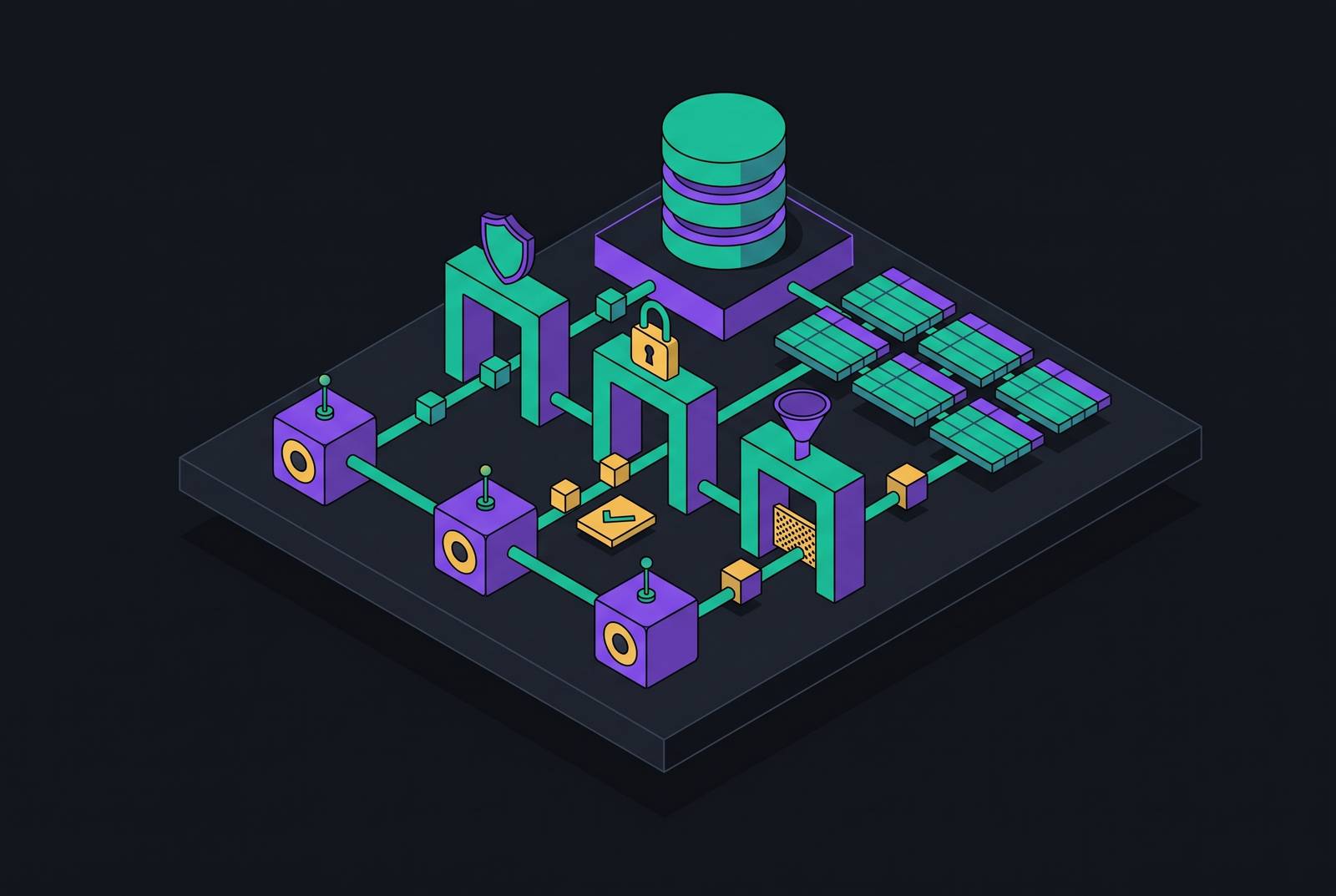
Governed data access for AI agents on Supabase via MCP requires an MCP server pointed at a governed analytical copy. The access layer must enforce task-scoped permissions, make pre-modeled metrics available, and keep an immutable audit trail of every action an agent takes. Prioritize those three requirements over enterprise catalog depth when evaluating tooling.
Why direct agent access to production Postgres is a governance failure, not just a security risk
When a team adds an agent to a Supabase project with a live connection and broad table access, analytical work enters the same database that serves the application. The agent can generate many small calls or long-running scans that compete with live traffic for CPU, memory, and connections. Postgres is row-oriented and tuned for transactional work. The aggregation workloads an agent creates can use up the connection pool before anyone finds which task caused the pressure.
The permission boundary can fail at the same time. An agent with a service-role credential can bypass row-level security, while a shared account does not keep permissions that are enforced only in application logic. Once sensitive data enters the model’s context window, it cannot be taken back. Preventing disclosure therefore requires enforcement before the query result reaches the agent.
Even an authorized query can produce an ungoverned answer. Raw tables show columns, but they may lack the agreed business definition of revenue or another metric. An agent can reproduce conflicting calculations at machine speed.
What the MCP standard changed — and what it left unsolved
Anthropic launched the Model Context Protocol in November 2024 to give AI systems a standard way to access external data. It separates the AI client, the MCP server, and the resource, and OpenAI, Google, Microsoft, and AWS have adopted it natively. That separation makes connectivity easier to provide. The resource behind the server may still be inappropriate for an agent.
The July 2026 MCP specification change made the protocol stateless at the protocol layer. Requests can reach any server instance behind a plain round-robin load balancer, making horizontal scaling easier for concurrent agent traffic. However, scaling the access layer does not isolate the database. An MCP server pointed at production Postgres still directs agent workloads toward production.
MCP also does not establish metric definitions or provide authentication by itself. Trend Micro’s July 2025 security study found 492 MCP servers exposed without authentication. The Linux Foundation and OpenID Foundation subsequently adopted the SAFE-MCP security baseline in 2026. For a Supabase team, the architectural implication is specific. The MCP server should point at a governed analytical copy so the access layer can scale on its own without putting more agent query pressure on the primary.
The three criteria that actually determine whether an agent-to-Supabase setup is governed
The evaluation has three non-negotiable criteria, namely access scoping, semantic-layer enforcement, and audit trails. Access scoping sets whether agents get least-privilege access at request time without keeping standing privileges on production. Semantic-layer enforcement sets whether they query agreed metric definitions or make up calculations over raw tables. Audit trails establish which agent acted, under whose authority, against which resource, and with what outcome.
All three must operate together in the deployed architecture. A tool that gates access without tracing actions leaves accountability incomplete. A tool that records actions without enforcing policy documents exposure and leaves it unprevented. Likewise, tightly scoped access to undefined metrics governs permission but not meaning. Catalogs, stewardship workflows, and lineage graphs can support this architecture, but their presence does not prove that these three controls exist.
Access scoping — how do agents query Supabase without direct database access?
A standing service-role credential on production gives an agent persistent authority where it should have none. Sharing that credential also prevents clean attribution and revocation at the individual-agent level. Governed access starts with a distinct identity. Each agent needs a named owner and a lifecycle that covers provisioning, active use, suspension, and retirement, rather than a borrowed human credential or shared service account.
That identity should receive privileges only for an approved task, with access expiring immediately on completion. Zero standing privileges is the target state. A controlled access point, such as an MCP gateway or API layer, must evaluate permissions and route analytical traffic to an isolated read replica or governed analytical copy, never the primary. Isolation takes pressure off the connection pool, while request-time authorization sets what the agent has authority to do.
Row-level security and attribute-based access control must be enforced at the source before results reach the agent’s context. Post-processing filters are not an adequate permission boundary. Quarterly reviews cannot substitute for this enforcement because an agent’s effective access can change with each task.
To evaluate this criterion, a team should ask the vendor to demonstrate task-scoped access, expiry, and policy evaluation on a request that reaches the isolated resource. C1.ai applies identity-aware policy at its MCP Gateway to MCP, tool, and API actions. Its approach includes just-in-time, time-bound access and human-on-the-loop approval for privileged operations. The demonstration should establish both where permission is enforced and where the query runs.
Semantic-layer enforcement — how pre-modeled data prevents agents from inventing their own metric definitions
Scoped access is not enough when agents are allowed to query raw tables whose business meaning is unclear. Permission answers who may query. If sales, finance, and product each maintain their own ARR definition, an executive team's arguments about numbers displace discussion of decisions. An agent distributes whichever interpretation its query happens to use.
Semantic enforcement starts with a data dictionary that has one agreed definition for each metric. Without that agreement, a semantic layer can make the wrong definition appear authoritative. Metrics should then be pre-calculated and stored in governed form, rather than assembled from raw tables by whichever agent asks first. Agents, dashboards, and human analysts should all query through the same layer.
For a Supabase team, that layer can expose pre-modeled, governed Parquet datasets or curated views queryable through DuckDB or an equivalent columnar engine. Analytical traffic stays off the OLTP primary. When the exposed surface contains only governed datasets and provides no route to raw tables, the restriction is structural rather than a request that the agent follow instructions.
The vendor test is whether metrics are governed objects with versioned definitions or merely tables behind an arbitrary-SQL tool. Domo illustrates the semantic pattern by letting agents query metrics through the same layer dashboards use. Governance is inherited from that shared layer.
Audit trails — what a governed agent access log must actually contain
Monitoring describes what is happening now, while audit establishes what happened under a particular authority. A performance dashboard cannot substitute for an immutable record. Access scoping and semantic enforcement become provable after the fact only when each action has enough attribution to reconstruct the decision and its outcome.
The record must identify the specific agent, its owner, and its operating role at the time of the action. It must also preserve the delegation chain, including who initiated the task and under what delegated authority the agent acted. The resource needs explicit identification as a table, view, or governed metric dataset. Raw SQL alone can be ambiguous without schema context. The record must connect that resource and action to the rule that allowed or blocked access and the result returned.
Supabase projects can use pg_stat_statements for mean_exec_time, total_exec_time, and calls, while the Supabase Metrics API exposes Postgres health and performance metrics in Prometheus format. Comparing active connections with max_connections is the key way to track pressure on the connection pool. Many small agent calls can accumulate without being attributable through these signals alone.
To test auditability in a proof of concept, a Supabase team should request one trace ID that connects the policy decision to the audit row and recorded outcome. The record must be immutable and preserve the full delegation chain. A successful monitoring demonstration does not satisfy this test.
How the available governance tooling maps onto these three criteria
The available tools address different parts of the framework. A Supabase team therefore needs to distinguish a product’s strongest criterion from proof that its deployment covers all three. Composition may be necessary. The comparison should also separate native agent governance from a separate product with its own licensing and roadmap.
For access scoping, C1.ai provides governed agent identities, lifecycle management, time-bound privileges, per-action policy evaluation, and delegation-chain attribution through the C1 MCP Gateway. Its fit is an access-layer requirement. BigID offers Agentic Access Control for AI agents with a focus on data privacy, security, and compliance. It uses cloud deployment, with pricing on request.
For semantic enforcement, another vendor combines governed analytics with agent supervision, limited autonomy, and human-validation control points. Atlan focuses on AI-ready context governance and automated propagation of governed context across connected systems. Its cloud deployment has native AI governance built in. Alation emphasizes search-driven discovery and adoption through its AIOS platform with Agent Studio, with cloud and on-premises options. These products meet related needs, but teams must test both whether they can find a definition and whether it is enforced on every agent query.
For audit requirements, Collibra offers its AI Command Center to oversee agents in real time and run stewardship workflows, mainly through cloud deployment. Its regulated-industry fit centers on audit artifact quality and policy-to-audit-row traceability. IBM watsonx.data intelligence provides Agentic Data Intelligence, context in watsonx.data, hybrid deployment, model cards, and impact assessments. Its fit is large enterprise and IBM environments. Informatica IDMC provides Agent Fabric Context Catalog, MCP support, and hybrid deployment for enterprise data management across mixed environments.
Some platforms span the three criteria within one environment. Databricks Unity Catalog combines lakehouse-native governance with Unity AI Gateway for models, agents, and MCP, bringing access, lineage, and policy into one layer. Its fit depends on the existing lakehouse. Ataccama ONE combines data quality and governance with ONE AI Agent, MCP Server support, and hybrid deployment, covering access, semantic context, and audit.
These prices are rough figures for planning and have not been quoted by a vendor. OpenMetadata and Apache Atlas are free to download but require engineering effort to operate. Mid-market platforms may start around $30K–$80K per year, while enterprise platforms can cost much more depending on scale. Unity Catalog comes bundled with existing Databricks spend, while Purview requires separate per-user licensing or pay-as-you-go Azure consumption charges. A custom price for the year can depend on the governed AI systems and seats.
For smaller Supabase teams, procurement and integration overhead can make these capabilities impractical to deploy. DuckDB-queryable copies remove agent query pressure from the primary, while governed Parquet datasets can restrict agents to pre-modeled data. That arrangement still needs request-time access controls and immutable attribution to satisfy the complete framework.
A practical evaluation sequence for teams deciding now
Begin with access scoping because a failure there creates immediate operational and security exposure. Ask the vendor to demonstrate that agents cannot hold standing credentials on production Postgres. The query destination must be part of that demonstration. If the tooling cannot establish this boundary, disqualify it regardless of catalog depth or compliance coverage.
Next, request a semantic-enforcement proof of concept in which an agent and a dashboard query the same metric through the governed layer. Compare the returned numbers. If they differ, the demonstration has not established a shared, enforced definition. Ask whether the agent receives a governed metric object or access to a tool that can construct its own calculation.
Then request the audit walkthrough for a specific action. Follow one trace ID from the policy that authorized the request to the immutable audit row recording its outcome. Require the record to include the governed agent identity and the full delegation chain.
Finally, check how well the deployment fits the size of the team and the existing stack. Ask about procurement, integration, licensing, and whether the proposed analytical layer needs a separate warehouse or a dedicated data engineer. Judge the complete arrangement. The decision should close the access, semantic, and audit gaps before the first agent touches production, while prevention is still an architectural choice.