The Indirection Layer That Keeps AI Agents Away From Your Supabase Production Database
A governed data layer and MCP server let agents query analytics without production database access.
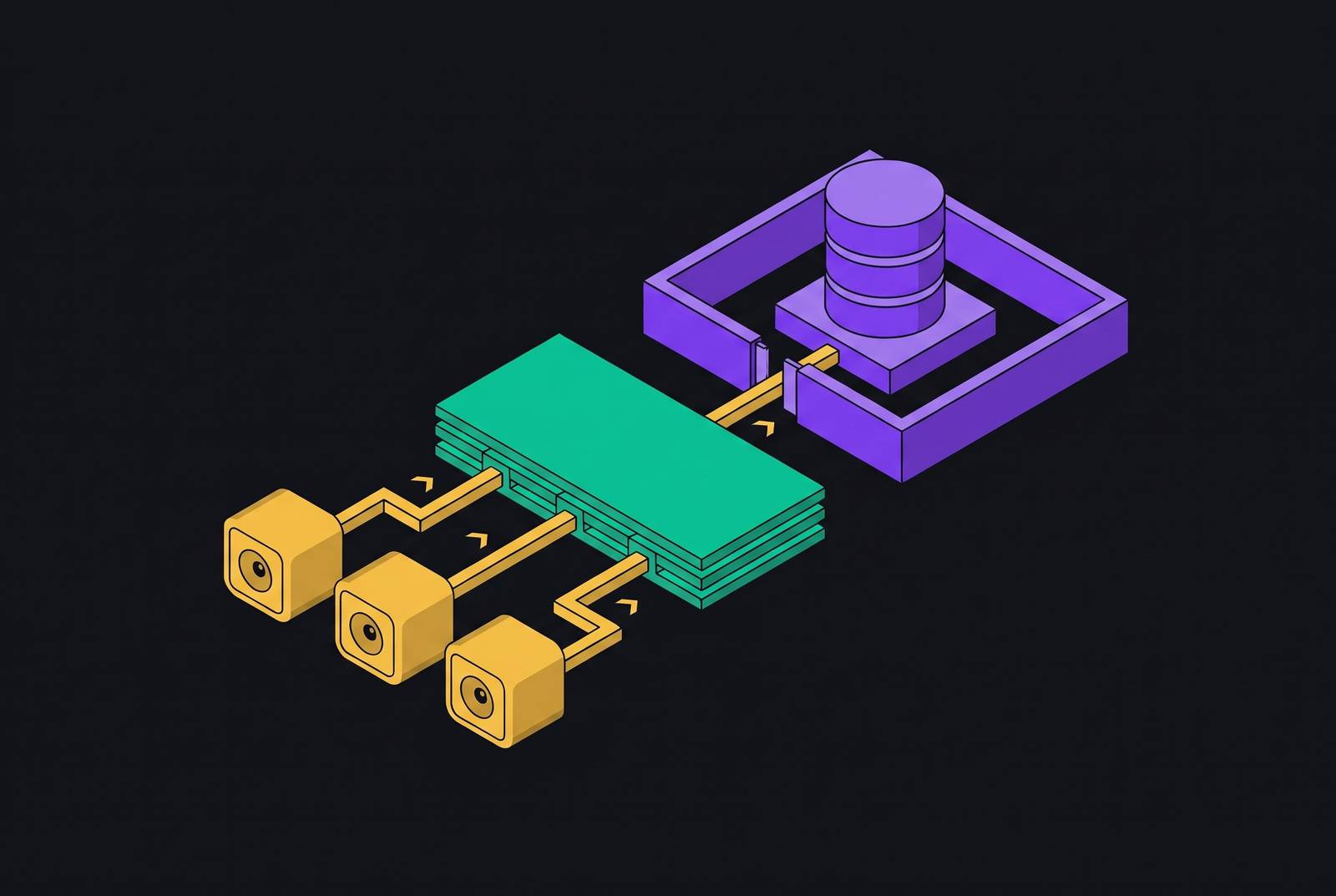
AI agents should query Supabase data through a governed data layer and an MCP server. The data layer separates analytical reads from production and stores approved datasets, while the server authorizes named tool calls before execution. This keeps reasoning separate from execution, so an agent can ask for a governed result without getting access to live production tables.
Why giving an AI agent direct database access is an authorization problem, not just a security risk
A bad file edit can be visible in code review. A bad query against a production table runs immediately, without that review step. This asymmetry makes database access different from an agent proposing a change for someone else to approve. The agent holds authority to act. The agent thus gets authorization without a separate check that each use is allowed.
The Open Agent Passport (OAP) paper describes how tool execution is decided either by the model or by ad-hoc application-layer validation, neither of which constitutes a security-grade authorization layer or produces a verifiable audit record. Instructions in a prompt do not close that gap. Parallax argues that prompt guardrails share the computational substrate of the threats they attempt to stop, so a compromised reasoning system also compromises its prompt-based protections.
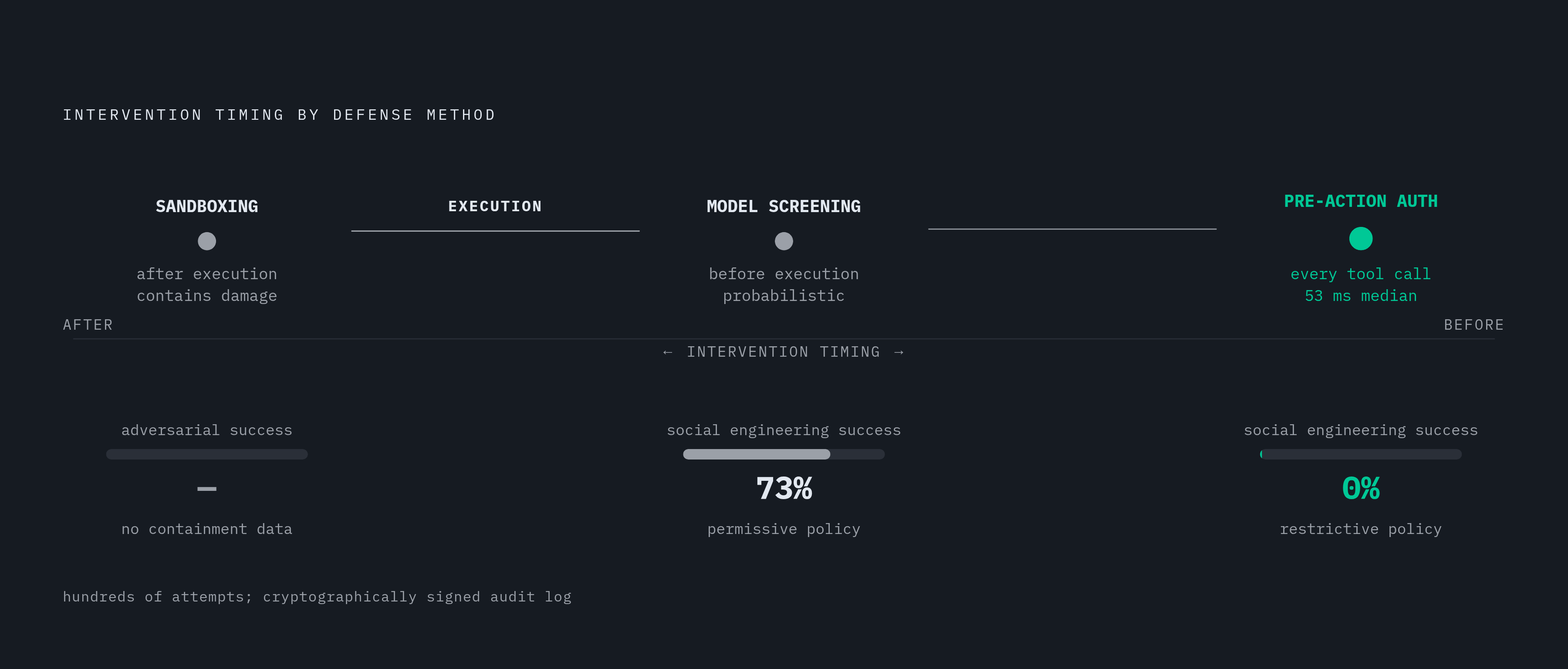
An agent reading a support ticket or stored table value cannot reliably distinguish untrusted instructions from data. Any authority it holds can consequently become available to an injected payload. The OAP paper found that social engineering succeeded nearly three-quarters of the time under a permissive policy, but a restrictive pre-action policy brought success down to zero across hundreds of attempts. A stronger model instruction is not equivalent to an enforceable boundary.
How do you let AI agents query Supabase data without direct database access?
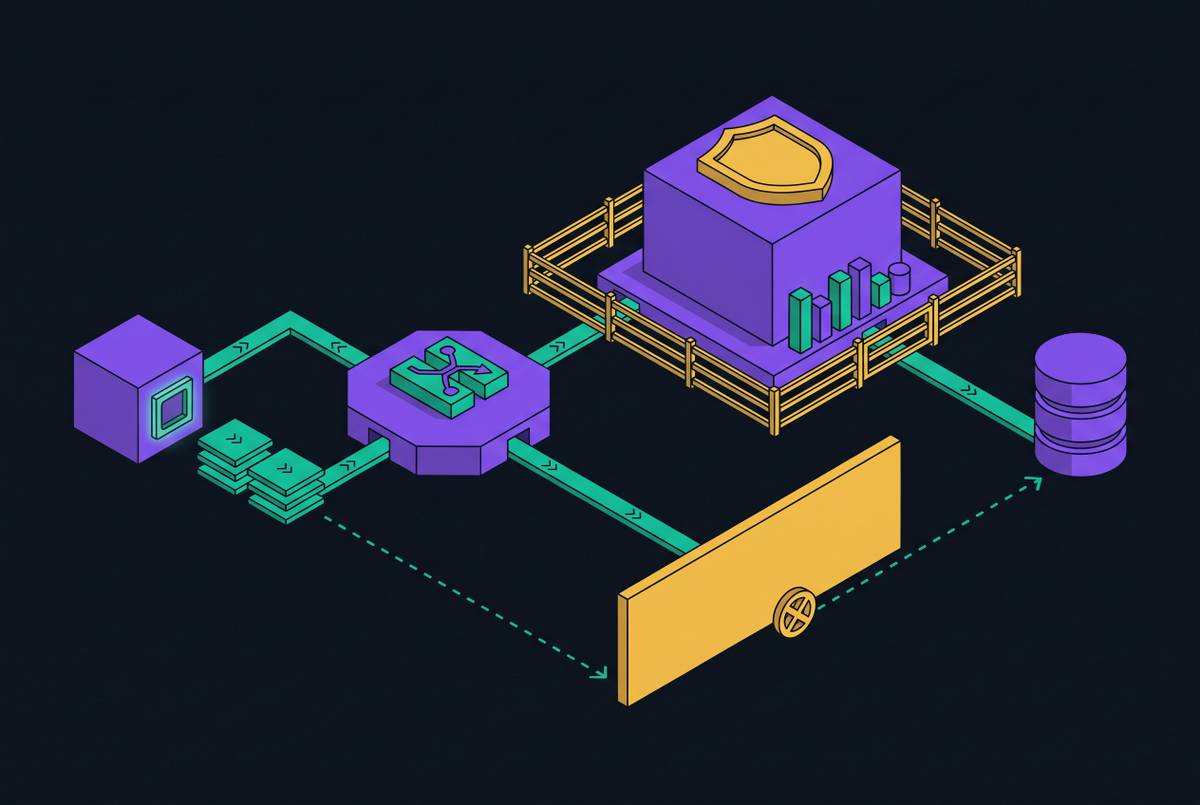
An indirection layer sits between the agent’s request and the system capable of executing it. The agent proposes an action, but an independent component decides whether that action may proceed. If the agent retains another path to the database, the intermediary has not structurally separated reasoning from execution.
Parallax names this principle Cognitive-Executive Separation and interposes an independent engine with a multi-tiered validation pipeline called Shield. It was tested with 280 adversarial test cases across nine attack categories. The boundary held under full agent compromise, blocking nearly all attacks with zero false positives under the default configuration and all attacks under the maximum-security configuration. These results apply only to that evaluation. This works because enforcement does not depend on being able to trust the reasoning system.
The OAP paper describes a corresponding synchronous intercept that evaluates every tool call against a declarative policy before execution and produces a cryptographically signed audit record. Enforcement took a median of 53 ms across a thousand calls. The same intercept can enforce quality gates, operational contracts, and compliance controls. Timing distinguishes it from other defenses. Sandboxing contains an action that has already executed, while model-based screening remains probabilistic and pre-action authorization prevents an unauthorized action from executing at all.
Why Supabase production databases are particularly exposed when agents connect directly
Supabase adds operational constraints to this authorization gap. Its production databases use a row-oriented OLTP engine, so analytical queries that scan large tables compete with application traffic. That load also appears on the Supabase bill. An agent’s ability to generate a valid query says nothing about whether production is the right place to run it.
Row Level Security, or RLS, addresses a different question. It governs which rows a credential can see. Policies designed for application users can also add friction to analytical queries. Reusing the application’s credentials compounds the problem because the agent may inherit application-level or admin-level permissions broader than its analytical task requires.
Supabase’s connection pooler has limits already occupied by production application traffic, and scan-heavy agent queries can exhaust that capacity and affect application latency. Restricting an agent to reads does not remove this competition.
The governed read replica as the first indirection layer
Supabase Read Replicas are designed to distribute read traffic and can isolate analytics workloads from production. That establishes physical separation rather than relying on application logic to keep queries restrained. Analytical consumers use credentials scoped to the replica.
A governed replica also enforces row and column-level filtering at query time, authenticates agents through replica-scoped tokens, and provides query tracing so their actions are auditable. These controls turn the replica into an authorization boundary. Without them, replication changes where a broad credential operates but does not sufficiently narrow what it authorizes.
A standard replica still uses the primary’s row-oriented engine and inherits its scan-performance limits. A columnar analytics replica goes further by placing replicated data in an engine built for large scans and aggregations. Supabase Pipelines provides a CDC path to a columnar destination when analytical workloads outgrow what a dedicated replica handles well. The layer above the replica must still constrain which operations agents can request.
The MCP server as the second indirection layer, and why most MCP implementations get this wrong
Anthropic launched the Model Context Protocol in November 2024 so AI systems could use a standard way to access external data through an MCP host, client, and server. That standardization does not itself establish governance. An MCP server can enforce policy, or it can simply forward requests using whatever database credentials it holds. The presence of a server therefore says little about the authority available through it.
MCP is an interface layer. It does not normalize schemas, repair data quality, or turn raw responses into governed metrics. For analytics, a governed server exposes tools that accept only a metric name, filters, and dimensions. Its tool definitions establish the permitted surface. Asking an agent to prefer approved metrics cannot stop semantic bypass if the agent can still use a raw query tool.
Authentication alone is also an incomplete test of safety. The OAP paper documented hundreds of production MCP servers exposed without authentication or encryption. It also reported that CVE-2026-26118, a CVSS 8.8 SSRF vulnerability in Azure’s MCP Server, was exploited through a valid authenticated credential, with no policy governing execution. Valid access did not establish permission for the action. For Supabase analytics, the relevant server criteria are named, pre-approved tools, refusal of arbitrary SQL, and policy enforcement over a governed data substrate.
What pre-modeled, pre-calculated datasets change about agent safety and metric reliability simultaneously
Named datasets constrain both access and interpretation at once. An agent consuming an approved metric receives its result without reaching the production rows that produced it. The agent also no longer invents the definition as it answers a question.
Without that boundary, plausible queries can produce conflicting answers. One query adds up one revenue field, while another adds up a different field. The answers can disagree even when there is no calculation error because the organization may never have agreed on which calculation measures the revenue it needs to track. A governed metric instead has an owner, a calculation, and a governance record. When agents consume the same pre-calculated dataset, they do not independently reconstruct its definition.
Governed Parquet files queryable through DuckDB provide one concrete serving pattern. Agents consume pre-calculated datasets without any path back to the production database, while the analytical context is fast and cheap to query. The unit of access is the modeled dataset. A named tool returns a governed result with provenance rather than allowing the agent to construct an alternative route to the underlying rows.
For early-stage teams, the lesson is to model the five or fewer actionable KPIs that drive decisions, including revenue, churn, usage, and their equivalents. Those definitions should be versioned and maintained separately from prompts. This gives humans and agents a shared analytical contract. It also makes metric ownership part of the data architecture rather than a convention that each consumer must remember.
How a single governed data layer keeps agents, humans, and the production database structurally separated
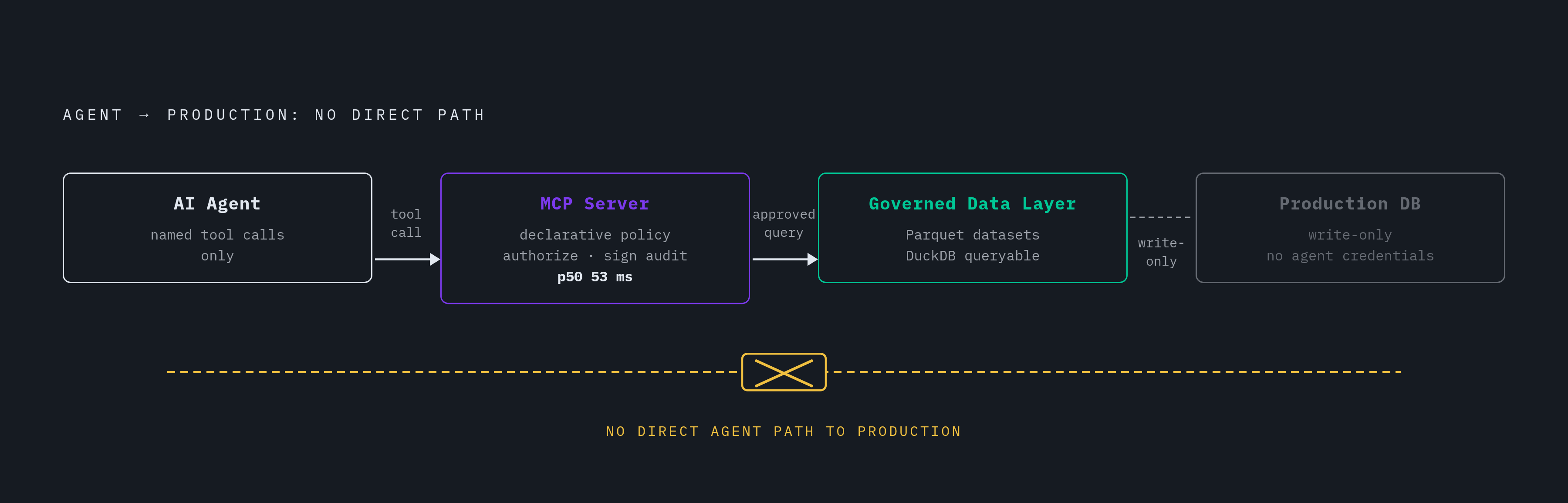
The complete system preserves three distinct roles. The production database is still where writes go and is the operational source of truth, while the governed data layer stores approved analytical datasets. Above that layer, the MCP server exposes only named, policy-bound tools. No agent credential authenticates directly to production, and the server is the only interface agents are permitted to call. Each component has a responsibility that the others cannot replace.
A request begins as a named tool call, is evaluated against declarative policy, and returns an authorized result with provenance. Every agent query is therefore also an auditable event. The data layer determines the approved analytical content, while the server controls what the caller can invoke.
The CEO dashboard and an agent’s weekly report can draw from the same pre-calculated dataset instead of maintaining separate definitions of the metric. Pre-calculation also supports delivery to a team messaging platform, an inbox, or a dashboard rather than depending entirely on someone remembering to request an update. These are downstream benefits of the separation. The governed layer can extend an existing Supabase Postgres project analytically without schema changes, an ETL pipeline, or separate data warehouse infrastructure being requirements of the architecture.
What to build first if your Supabase project already has agents in the loop
For teams with agents already connected, the recommended sequence begins with observability on the production database. Skipping directly to a new interface can produce a system that looks controlled without establishing the foundations beneath it. Observability must be followed by removing direct agent access.
The second step is a Supabase Read Replica with scoped credentials for analytical consumers, separate from the application connection string. With that change, agent reads no longer use the production primary’s connection pool. If aggregation-heavy workloads exceed the replica’s suitability, a columnar destination addresses the remaining engine mismatch. Read separation and analytical performance are related decisions, but they are not identical.
The third step is an MCP server backed by pre-modeled datasets and exposing only named metric tools. At this stage, the permitted interface must exclude arbitrary SQL paths to any database layer. Metric ownership must also be assigned before the governed layer becomes useful. One person owns what “active user” means or what “churn” counts, and that definition belongs in the pre-calculated dataset.
The reason to act is already present in the credentials. An agent with a production connection holds execution authority now, even if its current task is only to explain a metric. The architectural goal is not to persuade it to use that authority carefully, but to make that authority unavailable. A governed result should be accessible without making production accessible with it.